

Blogs
Can You Whip Single Cream? The Honest Answer (& What to Use Instead)
Jun
Wondering can you whip single cream? You’re not alone — it’s one of the most common kitchen mix-ups in the UK. The short answer is no, and if you’ve ever stood there with a whisk watching single cream stay stubbornly liquid, you’ll know exactly how frustrating that can be. This guide explains the science behind why it won’t whip, exactly which creams will, and how a cream charger can give you perfect whipped cream in seconds — every single time.
In This Guide
Why Single Cream Won’t Whip
Single cream contains roughly 18% fat. That sounds like quite a bit, but whipping cream requires fat molecules to do something very specific: they need to cluster around air bubbles and hold them in place, forming a stable foam. At 18% fat, there simply aren’t enough fat globules present to create that structure. The air bubbles collapse almost as quickly as they form, leaving you with nothing but frothy liquid.
Think of fat molecules like scaffolding. Below around 30% fat content, you don’t have enough scaffolding to support the structure of whipped cream. Single cream will never reach soft peaks, stiff peaks, or anything in between — it’s physically impossible, regardless of how long you whip it, how cold your bowl is, or how fast your electric mixer runs.
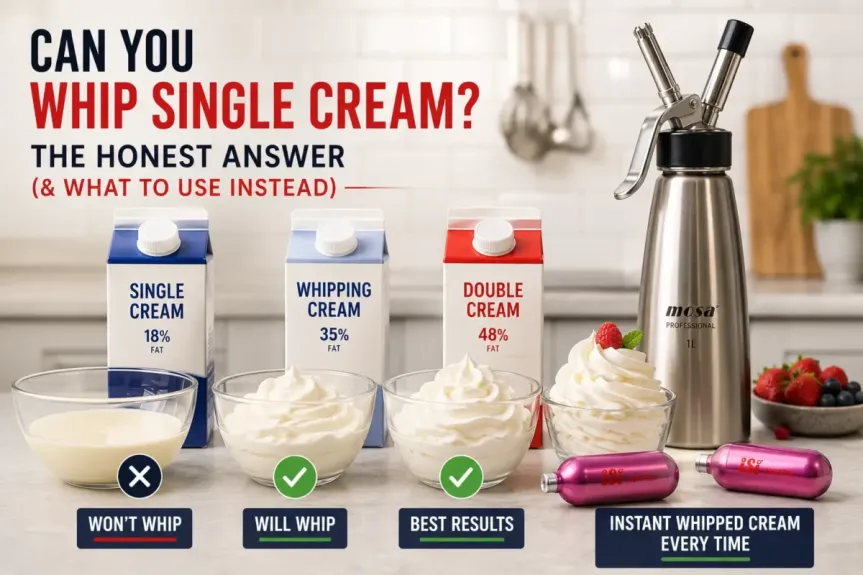
No, you cannot whip single cream. It contains only around 18% fat — well below the 30% minimum needed to whip. For whipped cream, use whipping cream (35% fat) or double cream (48% fat). Both can be whipped by hand, with a mixer, or using a cream charger and dispenser for instant results.
Fat Content: The Only Thing That Matters
When it comes to whipping cream, fat content is the single factor that determines whether it will work. Temperature plays a supporting role — cold cream whips faster and holds its shape better — but without sufficient fat, temperature makes no difference at all.
The reason fat content is so critical comes down to the structure of fat globules in cream. When you agitate cream mechanically (by whisking, beating, or pressurising with N2O), the fat globules partially coalesce and form a network around trapped air bubbles. This network is what gives whipped cream its light, airy texture and its ability to hold a peak. The higher the fat content, the stronger and more stable that network becomes.
This is also why double cream whips faster than whipping cream — its higher fat content (around 48%) creates a denser network more quickly. The trade-off is that double cream can over-whip into a buttery texture if you’re not careful.
Which Cream to Use for Whipping
In the UK, the shelves can be confusing — there are half a dozen different cream products and the naming isn’t always intuitive. Here’s what actually works for whipping cream in the UK, and what to avoid.
Double cream is the gold standard for most UK bakers. At around 48% fat, it whips quickly, holds its shape well, and can be piped without collapsing. It’s rich and indulgent, which makes it ideal for desserts, gateaux, and filling meringues.
Whipping cream sits at around 35% fat and produces a slightly lighter result than double cream. It’s a touch less rich, whips to a greater volume, and is often the better choice when you want whipped cream that isn’t too heavy — for topping hot chocolate, filling a Victoria sponge, or piping onto scones.
Extra thick double cream has already been homogenised to a spooning consistency and will not whip in the traditional sense. It’s delicious spooned over puddings, but don’t attempt to whip it.
Soured cream, crème fraîche, and single cream all fall below or close to the threshold and are not suitable for whipping. They have their own uses, but producing airy peaks isn’t one of them.
UK Cream Comparison Table
| Cream Type | Fat Content | Can You Whip It? | Best Use |
|---|---|---|---|
| Single cream | ~18% | No | Pouring, sauces, coffee |
| Soured cream | ~18% | No | Dips, dressings, baked potatoes |
| Crème fraîche | ~30% | Barely | Dolloping, sauces |
| Whipping cream | ~35% | Yes | Piping, toppings, fillings |
| Double cream | ~48% | Yes — best | Desserts, piping, charger dispensers |
| Extra thick double | ~48% | No | Spooning over puddings |
How to Whip Cream Properly
Once you’ve got the right cream — double or whipping — follow these steps for reliable results every time.
Chill everything first
Place your bowl and whisk (or mixer attachments) in the fridge for at least 15 minutes before you start. Cold equipment helps the fat globules stabilise faster. This makes a noticeable difference, especially in warmer kitchens.
Use cream straight from the fridge
Cream that’s been sitting at room temperature will take much longer to whip and may not hold its peaks properly. Always use it cold, straight from the fridge.
Whip at medium speed
Start at medium speed rather than full blast. This produces more even, stable bubbles. High speed creates large, unstable bubbles that break down quickly — and it’s very easy to over-whip double cream at full power.
Stop at the right moment
Soft peaks (tips curl over) are ideal for folding into desserts. Stiff peaks (tips stand straight) are better for piping. Stop the moment you reach your target — double cream goes from stiff peaks to grainy butter surprisingly quickly.
The Cream Charger Method: Whipped Cream in Seconds
If you want perfect whipped cream with zero effort — and none of the risk of over-whipping — a cream charger and whipped cream dispenser is the answer. You fill the dispenser with double cream, charge it with an N2O cartridge, shake it a couple of times, and dispense. That’s it. The nitrous oxide dissolves into the cream under pressure and expands the moment it’s released, creating light, airy whipped cream instantly.
This method is used professionally in restaurants and cafés across the UK — and it’s just as easy at home. It also keeps whipped cream fresh in the fridge for up to two days inside the charged dispenser, which you simply can’t achieve with hand-whipped cream.
For best results with a dispenser, always use double cream with at least 35% fat — and never single cream, which will simply clog your dispenser and produce watery foam. Browse our full range of whipped cream dispensers to find the right size for your needs, with next-day UK delivery available on all orders.
Frequently Asked Questions
Ready for Perfect Whipped Cream Every Time?
Skip the guesswork. Our cream chargers and dispensers give you light, airy whipped cream in seconds — with next-day UK delivery on every order.
